
.png)


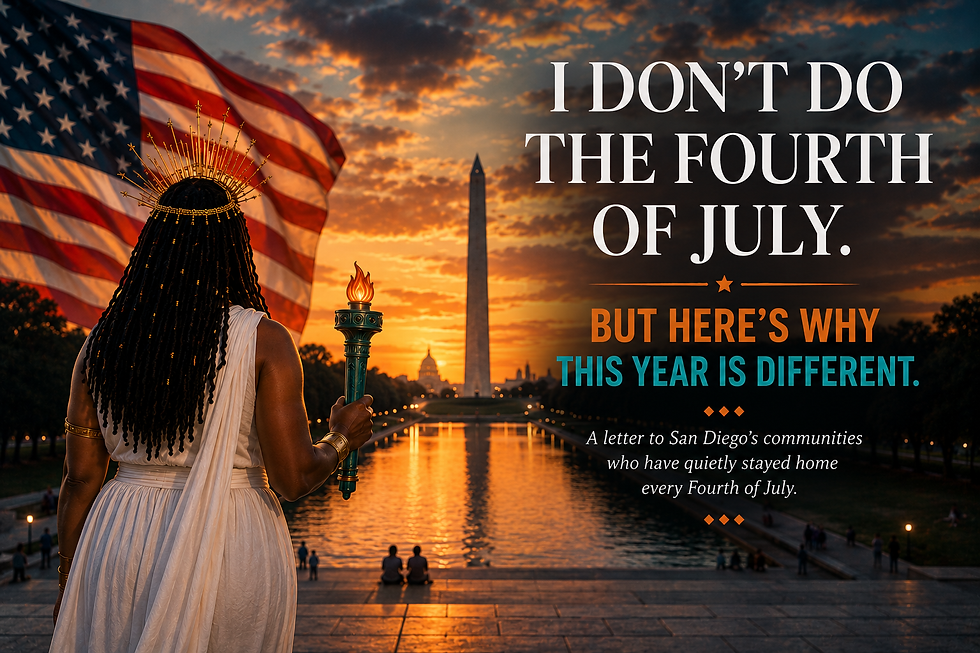
I Don't Do the Fourth of July. But here's Why This Year Is Different.

A letter to San Diego's communities who have quietly stayed home every Fourth of July
This Fourth of July, tens of thousands of San Diegans will gather at Waterfront Park to watch fireworks rise over the harbor. What many of them may not know is that this year, something historic is happening before the first firework rises.
On February 11th, the San Diego County Board of Supervisors voted 3-2 to amend the original Semiquincentennial celebration plan, requiring that it reflect the county's full racial and ethnic makeup, with the Office of Equity and Racial Justice given a formal role in shaping it.
It's worth sitting with why a 3-2 vote on a celebration needed to happen at all.
The original proposal was built on a familiar idea: a celebration for everyone, the same celebration, in the same form, for the whole county. That sounds fair, but it usually isn't. When a "universal" program is designed without asking who has historically been left out of the room, it tends to serve the people already closest to the center, and leaves everyone else to find their own way in, or not bother showing up at all. Supervisor Aguirre put it simply: if we're marking a national milestone, we have a responsibility to tell the truth about who built this country and why those lessons still matter. Supervisor Montgomery Steppe added that she loves her country, but is reminded every day of how complicated it is for us to come together, and that telling the full truth is part of loving it honestly.
That is not an attack on the Fourth of July. It's an invitation to finally mean it when we say it belongs to every American. One vote does not undo centuries of exclusion. But it opens a door that was not open before.
As a professional MC and experience curator (Queen Setche) who has spent years building remembrance and celebration ceremonies for families and communities across the country, I was invited to help curate and host the Black and African Community Stories segment at this year's celebration, the final community segment before the night's fireworks at Waterfront Park. I spent the past several weeks building it, and finding out just how many people in San Diego have quietly opted out of the celebration for years, not out of apathy, but out of an honest reckoning with what this day has historically meant for people who look like them.
When I first called Makeda, founder of the World Beat Cultural Center and a pillar of Black and African cultural life in San Diego for decades, to ask her to take part in this year's celebration, her answer came fast and unequivocally. She doesn't usually celebrate the Fourth of July. She celebrates Frederick Douglas Day because his fourth of July speech is more representative of her experience as a Black woman in a country that espouses equality but doesn't live up to it. I didn't try to talk her out of that. But I told her what this year's celebration actually was. I told her about the amendment and the vote, and that we weren't being asked to perform patriotism. We were being asked to tell the truth, in public, on the County's own stage.
By the end of the call she wasn't just willing. She was more excited than I was. Her journey from sitting this holiday out to belonging in this celebration is the story of what this amendment can do when it is honored with integrity. Makeda has since become one of the segment's most passionate contributors.
Her story is not unique. I have had some version of that same conversation more times than I can count over the past few weeks (as I invite friends and Queen Setche fans to the celebration), with Black San Diegans and members of the Hawaiian, Native American, and Latino communities who have spent years sitting this holiday out because it never felt like it was actually for them. Almost every one opened the same way: I do not do the Fourth of July. And almost every one, once they understood what this celebration is actually intended to be, said the same thing back: I'm excited. I will be there.
That shift, repeated over and over, is what the amendment actually made possible. America's 250th anniversary deserves more than a fireworks show. It deserves the full story.
Beginning at 6:00 PM, the evening features dedicated storytelling segments from several of San Diego's diverse communities, each given space to honor their histories and tell their part of the American story on their own terms. The Black and African Community Stories segment closes the evening, right before the fireworks begin.
We built it as a journey, not a showcase. It opens with a West African drum blessing and dance, music older than this nation's borders. From there it moves into a reckoning, spoken word built in the spirit of Frederick Douglass's 1852 question, What to the Slave is your Fourth of July, holding the full complexity of loving a country that has not always loved us back. Then it turns toward joy, through a collective Zydeco line dance, because joy and innovation have never been the opposite of struggle for us. They have always been one of our forms of resistance. From there, a reclamation performance, a return to the roots and brilliance of Black and African civilizations, long before anyone tried to erase us from the story of human progress and innovation.
And then, remembrance, gratitude, and hope, through a sacred candlelight ceremony.
As the night closes, before the fireworks begin, I will perform an original candlelight song, Their Spirits Live, written and adapted for this moment. Performers will walk forward one by one to lay candles before a graphic representing our ancestors. And I will ask everyone gathered, no matter where their family's story began, to say an ancestor’s name out loud into the night air. A grandparent. A freedom fighter. An unsung hero. Someone whose sacrifice quietly built the path they are standing on now.
This is an open invitation. Bring your ancestors with you. Whoever they are, wherever your people are from, the bridges they built are the ones we are all walking on tonight. I hope you will be there to say a name with us. Their spirits live!
If you, or anyone you know, has spent every Fourth of July at home because this holiday never felt like it was actually for you, I am asking you to consider showing up this year. Not as a concession. Not as compliance. Your presence at Waterfront Park this July 4th is reclamation, the same way the drums are reclamation. Nobody is asking you to pretend the history is simple. We are asking you to stand in the truth of it with us, together, and let that truth be witnessed by tens of thousands of people who are ready to hold it.
And if the Fourth of July has always felt straightforward and joyful for you, you are welcome in this space too. Come ready to listen, reflect, feel, and celebrate. Bring your ancestors, because everyone who has ever loved someone, lost someone, or been carried forward by someone else's courage has a name worth saying tonight.
San Diego's Board of Supervisors made a choice in February to tell the truth about America as we celebrate our 250th birthday. On July 4th, at Waterfront Park, we intend to honor that choice fully, with joy, with complexity, and with hope.
This kind of journey is not accidental. For years my work has lived at the intersection of grief and celebration, curating experiences that hold space for both at once, fully acknowledging loss, pain, and complexity, while still celebrating a life and arriving somewhere that feels like hope. That is not a contradiction. It is what people most need when they are asked to feel something true. It is also what this moment needs.
A nation is more than its founding documents. A nation is the accumulated dreams, sacrifices, courage, labor, shortcomings, love, and strength of generations of people whose spirits continue to live through us.
Setche Kwamu-Nana, who performs as Queen Setche, The Emotional DJ, is a professional MC, experience curator, and recording artist based in San Diego, best known for her unique approach to grief ceremonies, candlelight memorials, celebrations of life, and community remembrance experiences.


Comments